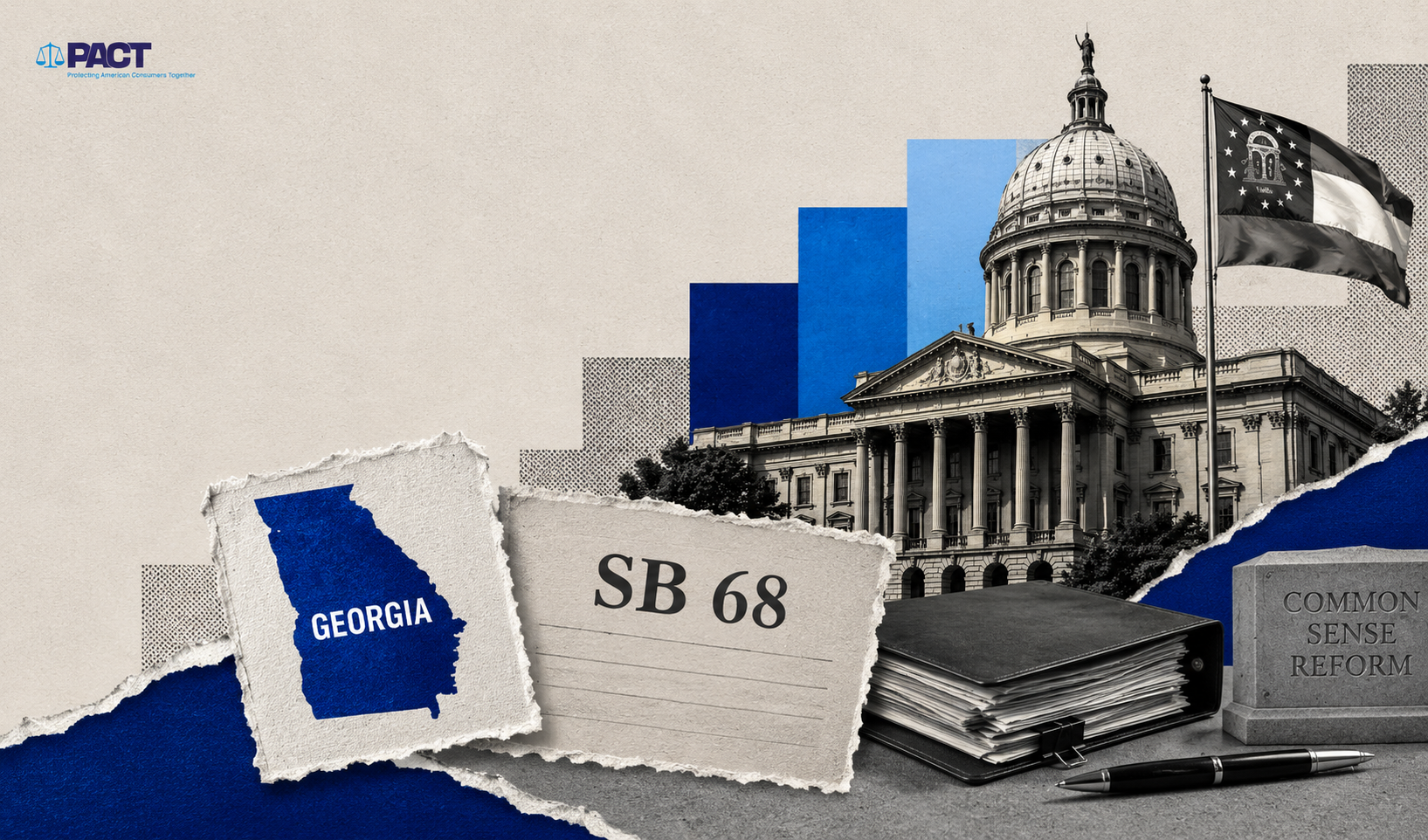
When Georgia lawmakers passed Senate Bill 68 in 2025, opponents warned of disaster. Trial lawyers and their allies insisted that the legislation would harm victims, block access to justice, and deliver nothing but windfall profits to insurance companies who would never pass savings on to consumers. One activist went so far as to assert that insurers don’t reduce premiums after tort reform. They simply pocket the savings. Those predictions made for compelling political arguments. They just weren’t true.
The R Street Institute’s latest analysis lays out the early results plainly: the sky has not fallen, plaintiffs continue to have their days in court, and the insurance market is responding in ways that directly benefit Georgia families.
To understand how significant this is, consider what SB 68 actually did. As R Street explains, the measure simply aimed ““to curb lawsuit abuse in many ways, including limiting attorneys from cherry-picking more favorable judicial jurisdictions; permitting juries to consider seat belt usage in car accident cases; ending jury awards for phantom damages; and reforming premises liability so that companies are not unfairly held responsible for injuries that occur near their businesses.” Most Georgians would call these commonsense reforms. The opposition called them catastrophic. They were wrong.
The data is unambiguous. In late 2025, Georgia’s Insurance and Safety Fire Commissioner announced that Liberty Mutual planned to reduce premiums by an average of 5.7%, State Farm by a total average of 10% from the previous year, and Safeco by around 5%. In February 2026, Allstate filed plans to reduce rates by 5%. In April, Travelers Property Casualty Insurance Company introduced plans to reduce premiums by over 10%. Then in June, filings showed that USAA would “lower rates, on average, by 4.7% at Garrison Property and Casualty Insurance Company, 4.5% for USAA Casualty Insurance Company and 2.4% for USAA General Indemnity Company,” according to WSB-TV.
Georgia auto rates decreasing and market stabilization reflect what Georgia Insurance and Safety Fire Commissioner John King put plainly in a recent op-ed:
“Georgia took meaningful steps to restore balance to its legal system, while preserving the right of every Georgian to seek justice when they’ve been wronged. The goal was simple: Rein in abuse without undermining legitimate claims. One year later, the early results are not just encouraging, they are measurable. Insurance costs are beginning to stabilize and, in many cases, decline.”
Perhaps the most striking data point is one that has nothing to do with insurance companies. MARTA, the Metropolitan Atlanta Rapid Transit Authority, recently presented a proposed FY 2027 budget forecasting just $27 million for casualty and liability costs, compared to $69 million in fiscal year 2025. A MARTA spokesman attributed the drop directly to “a reduced risk profile due to tort reform.”
These results mirror what Florida demonstrated before Georgia: that meaningful, commonsense lawsuit abuse reform leads to real, measurable relief for consumers. The critics said it wouldn’t happen here. The data says otherwise. Lawmakers in states still suffering under the weight of lawsuit abuse, from New York to California, should be paying close attention.
Georgia has shown that reform is possible, reform works, and consumers are better off because of it. The only question left is why it was ever controversial in the first place.