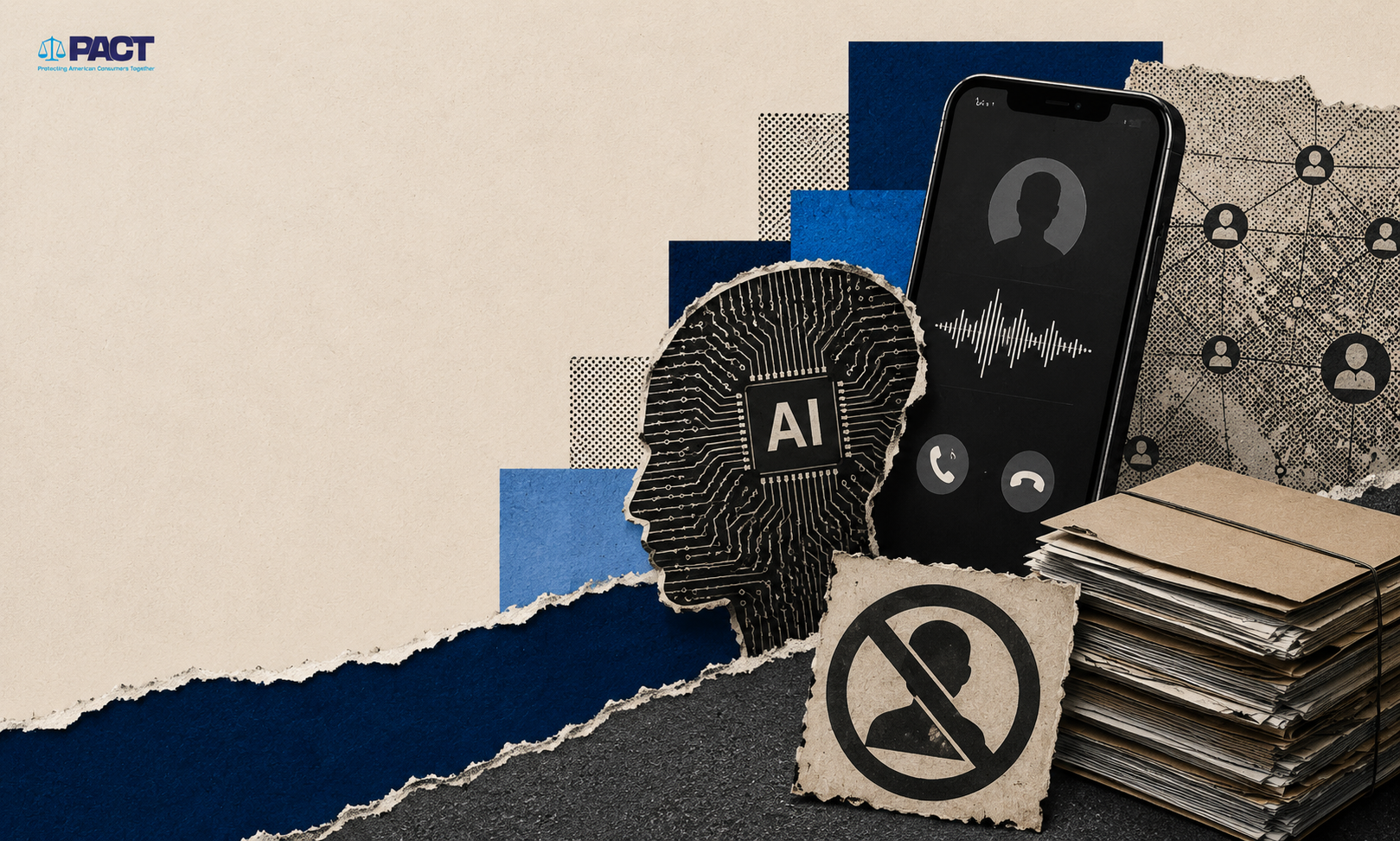
The billboard attorney playbook has a new tool: artificial intelligence. A federal lawsuit filed last week in the Western District of Texas reveals how far some personal injury firms are willing to go to fill their client pipelines, and how little regard they have for the consumers on the receiving end.
The putative class action, Emily Sutton v. DV Injury Law PLLC et al., accuses three affiliated mass tort law firms of deploying an AI-powered automated calling platform to contact thousands of people without their consent. According to the complaint, an “AI voice” placed materially identical solicitation calls from lead lists and dialing records, never verified that recipients had consented to being contacted, and continued pressing prospective clients with questions even after they declined. When plaintiff Emily Sutton asked who was calling, the AI voice identified itself as DV Injury Law and provided a Michigan address, but the caller ID had concealed the firm’s identity from the outset. Sutton’s complaint makes the firm’s intent plain:
“The AI voice continued to solicit plaintiff after she expressly and repeatedly declined, and the caller identification transmitted with the call concealed defendants’ identity, both reflecting a deliberate solicitation campaign rather than an inadvertent contact.”
The firms allegedly failed to register with the Texas Secretary of State as required of telephone solicitors under state law, suggesting the campaign was structured with little concern for the legal guardrails designed to protect consumers from precisely this kind of conduct.
This conduct did not occur in a vacuum. Personal injury firms have long relied on aggressive client recruitment tactics, including paid runners soliciting accident victims at hospitals and crash scenes, referral networks between attorneys and medical providers, and mass advertising campaigns that now outspend large pizza chains. AI-generated robocalling is simply the latest iteration of the same underlying business model: acquire clients at volume, at any cost, with as little friction as possible. According to the complaint, the defendant firms advertise across dozens of mass tort categories, including Ozempic, PFAS, Roundup, Camp Lejeune, talcum powder, and hernia mesh litigation, reflecting a high-volume operation built around systematically identifying and converting potential plaintiffs into cases. Thousands of calls were placed, Sutton alleged, “from lead lists and dialing records without verifying that the persons called had given prior express consent,” meaning real people with no connection to these firms were swept into a solicitation machine they never asked to be part of.
The harm to consumers is not abstract. Sutton’s complaint alleged privacy concerns, according to the suit, by every other person who received one of these calls. These are not minor inconveniences. They are the predictable consequence of treating human beings as entries on a lead list to be processed by an algorithm.
The profit motive here is unmistakable. Mass tort litigation is enormously lucrative for the firms that aggregate plaintiffs, and the competitive pressure to build those client lists faster and more cheaply than rivals is intense. A report from the American Tort Reform Association found that in 2024, $2.5 billion was spent on legal services advertising across 27 million ads nationwide, a 39% increase from 2020. AI-powered robocalling is a logical next step for an industry that has already demonstrated it views consumers not as clients to be served, but as volume to be acquired. The people who suffer most from this industrial approach to personal injury law are often the very individuals these firms claim to represent, left with diminished settlements, predatory loan agreements, and unnecessary medical procedures, while attorneys collect their fees.
Lawmakers and regulators at every level must recognize that the personal injury industry is evolving faster than the rules meant to govern it. The emergence of AI-driven solicitation campaigns demands a serious look at whether existing consumer protections are sufficient, and whether the broader incentive structures driving this conduct will continue to generate new abuses so long as the financial rewards remain unchecked.
Commonsense lawsuit abuse reform, greater transparency requirements, and meaningful accountability for firms that treat the legal system as a client acquisition engine are not just good policy. They are essential to protecting the millions of Americans who pick up the phone not knowing they have already been profiled by an algorithm.