Read full article at Fox 8 Live
By Thanh Truong
JEFFERSON, La. (WVUE) – Federal prosecutors say dozens of drivers intentionally crashed into 18-wheelers between 2015 and 2020, hoping to secure large insurance payouts through bogus lawsuits.
The staged crashes, many of which took place in New Orleans East and Gentilly, became the focus of a years-long federal investigation that exposed a network involving drivers, passengers, attorneys and medical claims.
Randy Guillot, president of Jefferson Parish-based Triple G Express, said his company was among those targeted.
“The insurance we carry, our policy limits are $2 million. That’s a lot of money,” Guillot said.
Guillot is a third-generation trucker and president of Triple G Express, a transportation company based in Jefferson Parish. In his decades of trucking, Guillot says he’s never seen the kind of fraud that targeted some of the 18-wheelers.
“My eyes went, I couldn’t believe it. We started seeing some signs, maybe in the 2010 area, that certain accidents just didn’t seem normal to us and we’ve been in the trucking business for a long time,” Guillot said.
It was around 2017, Guillot says, when one of his trucks got involved in what eventually would be exposed as a rigged accident. According to Guillot, his driver was coming down the Danziger Bridge when an SUV hit the truck on purpose. Three people sued for injuries and thousands of dollars in medical bills. The plaintiffs claimed Triple G Express’ vehicle hit the SUV, but Guillot says surveillance video from the truck and a nearby business captured a different scenario.
“In my staged accident, the person who was not even involved in the accident that claimed that he was driving, he wasn’t in the car at the time of the collision. He was in a separate vehicle, jumped into the driver seat. He received $90,000 of medical treatment that he didn’t need. He wasn’t even in the car,” Guillot said.
Following an FBI investigation into those kinds of accidents, the plaintiffs pleaded guilty to staging the wreck. In 2021, Danny Patrick Keating, the personal injury attorney for their lawsuit, pleaded guilty to conspiracy to commit wire fraud. Keating admitted to paying another cooperating government witness, Damien Labeaud, to stage 31 accidents. Keating told investigators he represented 77 plaintiffs in subsequent lawsuits. Federal authorities say such fake crashes predominantly took place in New Orleans East and Gentilly, often close to one truck stop.
“I was told by defense attorneys that we had well over 200 documented (staged accidents) and over $50 million in payouts, and a lot of these payouts were coming from my friends in the trucking industry,” said Randy Guillot.
“I was on my way to Mississippi to bring a load of bananas to the Mississippi port,” said Fred.
In 2018, another truck driver for Triple G Express, whom we’re calling Fred, says his tractor-trailer was caught up in a staged wreck near Louisa Street and the Highrise Bridge.
“He just tapped the back of the wheel and the little fender on the Jeep, all of that came off. But if I’m carrying 40,000 pounds, if you tap it with fiberglass, of course it’s gonna rip it off. He got out of the driver seat he run around and the young lady coming from the other side of the vehicle got into the driver seat. He went around to the passenger side to the back of the truck and she came around and got into the driver seat as if she was the driver. I was like I’m being set up. That’s the first thing that came into my mind. I’m being set up,” said Fred.
Fred agreed to be interviewed if we obscured his face and altered his voice. He says there’s a real danger in talking about what federal prosecutors described as sinister plots. Safety has also been a concern for Randy Guillot. When Guillot served as the chairman of the American Trucking Associations in 2019, he was spreading the word about the fake wrecks.
“For me, certainly my family’s safety and security is absolutely first on my mind,” said Guillot.
In the recent federal trial focused on staged 18-wheeler accidents, prosecutors laid out fraud schemes with a lot of tentacles. They included doctors willing to perform unnecessary surgeries, to the 2020 murder of a driver or so-called slammer, Cornelius Garrison, who had been informing the FBI on the rigged accidents in which he was involved. Among all the accused in the schemes, Guillot says the true source of the scams can be found in the law community.
“I truly believe that people involved in the accidents are being used as a pawn for a bigger industry. The plaintiff bar across the country compares notes, and if it works here in New Orleans, they’ll advertise. They’ll go out and tell their buddies in Georgia. They’ll tell their buddies in Texas. And whatever works in California, they’ll be telling folks in Florida,” said Guillot.
In March, a jury convicted personal injury attorneys Jason Giles and Vanessa Motta of numerous charges, including conspiracy to committ wire and mail fraud. Prosecutors said Giles and Motta orchestrated years worth of crashes, paying drivers and passengers willing to risk a collision and then cashing in through bogus lawsuits. Members of the U.S. Attorney’s Office in the Eastern District of Louisiana say Vanessa Motta and Giles tarnished their own profession.
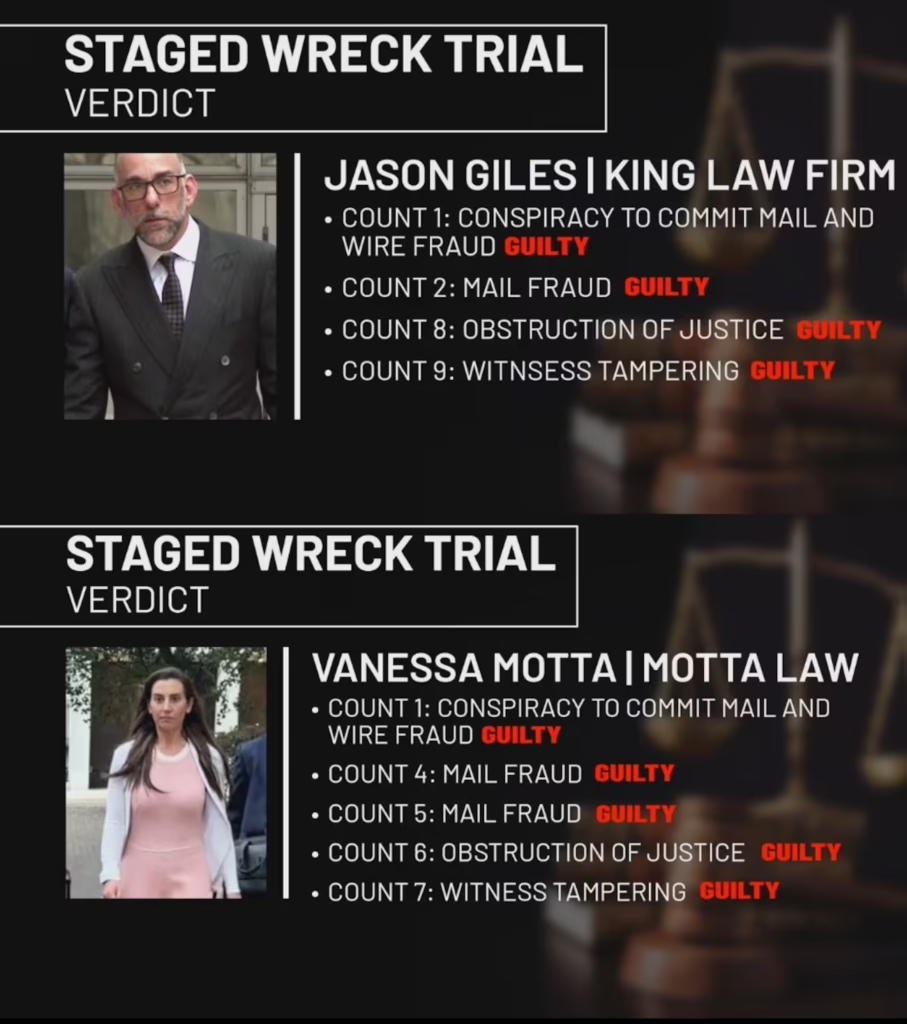
“Vanessa Motta and Jason Giles abused their positions and violated their oaths as attorneys. This is an example of the worst of the worst of what lawyers can be but shouldn’t be. And to me, this is a glaring example of what happens when lawyers push the boundaries in a way that it was never intended by the code of ethics or the code of professional responsibility,” said Michael Simpson, First Assistant U.S. Attorney for the Eastern District of Louisiana.
During the three-week trial, testimony from dozens of witnesses gave a raw look into a network of high-stakes fraud in New Orleans, which ultimately, paved the road to higher auto insurance in Louisiana.
From 2021-24, the Louisiana Department of Insurance saw auto premiums in the state rise every year, with double-digit percentage increases in 2022-23. A dip occurred in 2025, but Louisiana still ranks at the top of most lists of priciest places for car insurance in the U.S., with the average cost of full coverage climbing above $4,000 per year, according to Bankrate.
Louisiana Insurance Commissioner Tim Temple says the cost of litigating and settling all those fake insurance claims trickles down.
“Anytime you have cost, the insurance companies are going to take it and pass it down to the consumer. Whether it’s tens of millions or hundreds of millions of dollars, that’s money the insurance company had to pay out that we as citizens had to fund through premiums,” said Tim Temple, commissioner at the Louisiana Department of Insurance.
During Louisiana’s 2025 legislative session, state lawmakers passed a set of bills seeking to rein in what the governor called frivolous lawsuits. There’s now a law requiring anyone suing for injuries from a car crash to prove those injuries actually occurred during the accident. A major goal for the state is to lower car insurance premiums.
“It was needed. They were big steps, but that reform, in my opinion and from everything that I see as the commissioner, as a regulator, that really hasn’t started factoring into the rate decreases we’ve seen. Not yet at least,” said Commissioner Temple.
Guillot said Triple G Express has added live cameras to all of its trucks so incidents can be captured in real time and shared with law enforcement.
“Now, all our cameras in trucks are live,” Guillot said. “We not only can recapture any incident that happens in real time, we can also send it to the driver’s phone so he can show law enforcement.”
He said those protections cost money, and those costs are eventually passed down to consumers.
“Every one of these trucks are delivering groceries, delivering medicine, clothes, delivering furniture,” Guillot said. “Everything you’re touching, the camera you’re filming me on came from a truck. So, every incremental increase goes back to the consumer some kind of way in transportation.”
Fred said the experience changed the way he drives.
“Every time someone just drives on the side of me, yes, I think, what are you up to,” he said.