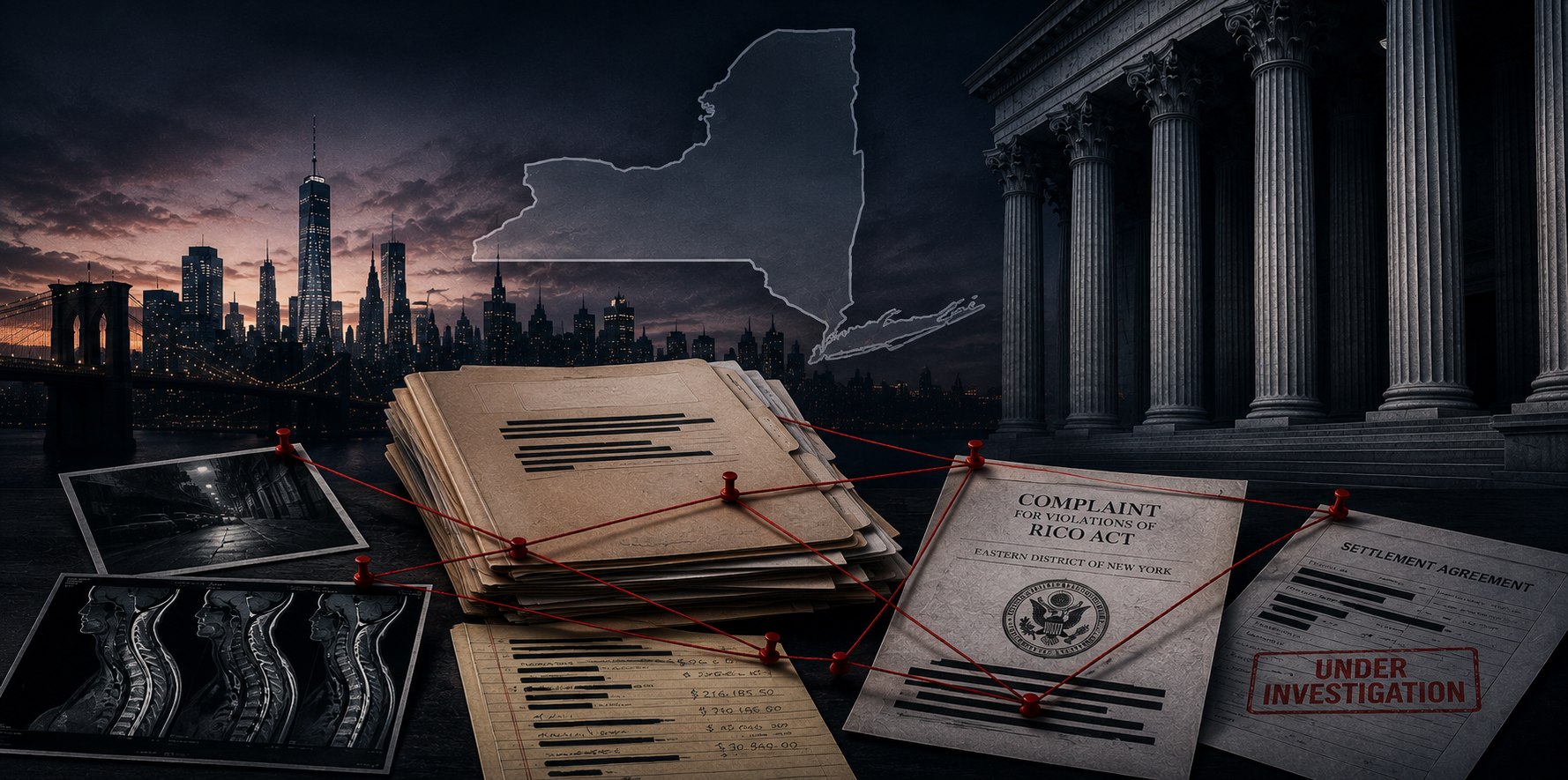
A new federal lawsuit filed in June 2026 does something previous court filings have only gestured at: it draws the entire blueprint. Not just the fraud, but the system. Every role, every participant, every financial incentive, laid out in 149 pages of sworn federal allegations that amount to the most detailed exposure of New York’s personal injury fraud machine ever put before a court.
The case, Wesco Insurance Co. et al. v. Liakas Law, P.C. et al., filed June 2 in the Eastern District of New York, names Liakas Law, P.C., one of the borough’s most prolific personal injury firms, alongside a neurosurgeon, orthopedic providers, an ambulatory surgery center, a New Jersey hospital, and a Bahrain-based private equity-backed medical management company that the complaint calls “an institutional-grade violation” of New York law. The plaintiffs are three AmTrust Financial subsidiaries that collectively paid over $2.6 million in settlements across just four exemplar claimants. Those claimants, the complaint alleges, were funneled through staged or grossly exaggerated accidents, unnecessary surgeries, and litigation funding arrangements that left them with little to nothing.
The complaint’s most striking passage is also its most damning. It describes the scheme not as opportunistic wrongdoing, but as a deliberately engineered system with assigned roles:
“Runners recruited claimants. Attorneys filed lawsuits. Gatekeeper clinics generated treatment records. Radiology providers manufactured reports supporting surgical indication. Surgeons performed invasive procedures. Litigation funders financed the process in exchange for repayment from settlement proceeds. Each participant played a defined and indispensable role in transforming routine accidents into high-value litigation assets designed to coerce settlements under the pressure of mounting defense costs and catastrophic exposure. Teamwork was essential, not incidental.”
This was not a cottage industry. It was a production line, with private equity at one end, claimants at the other, and every professional in between taking a cut.
At the center of the alleged enterprise was Liakas Law, whose case filings peaked in 2022 and then dropped off, the complaint notes, “precisely as purported occurrences from 2020 would begin to pass the statute of limitation.” That timing is not coincidental according to the plaintiffs. It is evidence of design.
Runners, referred to internally as “investigators,” “brokers,” and “client services liaisons,” recruited claimants. The complaint notes that a “statistically significant number of Liakas claimants” lived on Long Island yet “universally have purported trip and falls on sidewalks in Bronx, Brooklyn, and Queens.” Governor Hochul flagged this very pattern during a February 2026 address on fraud driving New York’s sky-high auto insurance rates, calling out “rampant fraud and runaway litigation costs” as the core drivers of premiums that now average $4,000 per year, the highest in the nation.
Once claimants were signed, they were routed to gatekeeper clinics owned not by physicians, but by Health Plus Management, LLC, a Delaware company acquired in 2019 by InvestCorp, a private equity firm headquartered in Bahrain. HPM held perfected secured interests in the clinics’ entire non-governmental accounts receivable. It controlled their marketing, staffing, payroll, scheduling, and their “medical and legal referral sources.” The complaint is direct in its allegations: HPM offers personal injury attorneys “a one-stop shop backed by private equity, where attorney referrals turn into a web of self-referrals, and overtreatment is directly tied to bottom line metrics.”
The on-paper physician-owners, the complaint alleges, “just show up, sometimes just on the billing.”
What elevates this complaint beyond the usual fraud allegations is its granular clinical detail. For Claimant B, podiatrist Siddhartha Sharma, who the complaint establishes did not hold Standard or Advanced Ankle Privileges in New York, allegedly performed a multi-procedure ankle arthroscopy including ligament repair, tendon repair, and debridement. The documented operative time: 18 minutes.
The complaint does not mince words: “This is facially not credible. Such a duration would be medically impossible.”
The imaging, the complaint adds, “only depicts mild synovium cleanup, a procedure which would itself take approximately 18 minutes from incision to close,” meaning the surgery as described on paper could not have occurred as described.
For Claimant A, a 26-year-old woman who presented to an emergency room after a slip-and-fall, neurosurgeon Anders Cohen allegedly performed a two-level cervical fusion five months later. The pre-surgical MRI showed no issues or injuries requiring surgery. The complaint alleges that the diagnoses justifying the surgery appeared for the first time in Cohen’s operative report, on the day of the surgery itself, and were “flatly contradicted” by every prior clinical record. Cohen used proprietary spinal devices for which he received royalties. The implants alone were billed at $30,840. Total billed for the surgery: $216,185.50.
The complaint’s conclusion on why this surgery was performed: “It is alleged Cohen made the unjustifiable determination to perform this surgery for economic motive having to do with his referral stream and royalties without consideration of medical necessity.”
The Funder’s Dilemma, for the Claimant
Litigation funders, described in the complaint as advancing money structured as “purchases of receivables” rather than loans, at rates that “would otherwise be usurious,” paid surgeons upfront to secure their cooperation and advanced cash to claimants to keep them in the litigation. The incentive structure was built to prolong cases, not resolve them.
The complaint observes that this structure “incentivizes the prolonging of lawsuits and rendering of unnecessary care, often leaving Claimants as the party (in theory supposed to be recovering near 66.6%) receiving the smallest portion of recovery.”
This is not a new observation. A 2025 federal complaint against William Schwitzer and Associates described a nearly identical architecture, with lawyers, doctors, and funders allegedly conspiring to walk clients into what the insurer called a “bear trap,” with one claimant in that case receiving just 13 percent of a $3.75 million award while funders and attorneys extracted the rest. In 2025, a Long Island fraud scheme uncovered by Newsday described residents of the same Freeport apartment complex being recruited to stage slip-and-fall accidents in Brooklyn and Queens, then routed to the same law firm and the same network of compliant medical providers. The Liakas complaint makes explicit that its claimants followed the same geographic pattern, from the same region of the Dominican Republic.
What the complaint makes viscerally clear is that insurers are not passive victims. They are structurally compelled to participate. Under New York law, the duty to defend triggers the moment a complaint is filed, regardless of whether the claim is fraudulent. The Liakas firm, the complaint alleges, knew this. It used mandatory disclosures to identify policy limits, then manufactured surgical escalation to push claims toward those limits. Each surgery increased Liakas’s chances of a bigger payout, and more money in their pockets. Each excess verdict threat coerced a settlement. The very mechanism designed to protect insureds was weaponized to extract money from their carriers.
“Faced with this artificially created exposure, insurers were pressured to settle claims that would otherwise have little or no value.”
The complaint describes this as extortion within the meaning of the federal Hobbs Act, not metaphorically, but as a specific legal predicate for RICO liability. The object of the scheme, as the complaint states plainly, was “to extract insurers’ money through fear of economic harm.”
This complaint lands at a pivotal moment. Earlier this year, a federal RICO case against the Ikhilov Law Group revealed yet another staged accident ring, this one using FedEx vehicles as targets. In February, Governor Hochul named the same Dominican Republic-origin claimant pattern in her State of the State address and proposed sweeping reforms. In May, she signed those reforms into law, with experts projecting premium reductions of $200 to $300 per driver annually.
That is progress. But as this complaint makes clear, the system these reforms are meant to dismantle did not operate in the shadows. It operated in plain sight, through licensed attorneys, credentialed surgeons, registered medical clinics, and a Bahrain-based private equity firm with perfected liens on clinic receivables. Every layer was legal on its face. The fraud was in the architecture.
Florida proved that reform works. Georgia followed. New York is beginning to act. But the Liakas complaint is a reminder of what remains at stake, and of how sophisticated, how financially integrated, and how deeply embedded this machine has become.
Reform is not just warranted. It is overdue.
Policymakers, regulators, and consumers deserve a legal system built around justice, not one engineered to extract settlements at the expense of the people it claims to serve. Support commonsense lawsuit abuse reform.