When Ann Bennett, a representative of the Washington Cities Insurance Authority, testified before the Bainbridge Island City Council on July 21, 2026, she described a legal system that is failing cities, and by extension, the taxpayers who fund them. Her testimony was local in setting but national in implication.
At the center of her remarks was a legal doctrine called joint and several liability, sometimes called “deep pocket” liability. Under this rule, a defendant found even minimally at fault can be held responsible for an entire verdict. Bennett put it plainly:
“A jury could find the city 10% at fault and another party 90% at fault. If the 90% party lacks the assets to pay the judgment and the plaintiff is fault-free, the plaintiff can collect 100% of the damages from the city, despite the city being only 10% at fault.”
The result is what Bennett called a “somebody has to pay” dynamic, where billboard lawyers do not search for the most culpable party. They search for the richest one one.
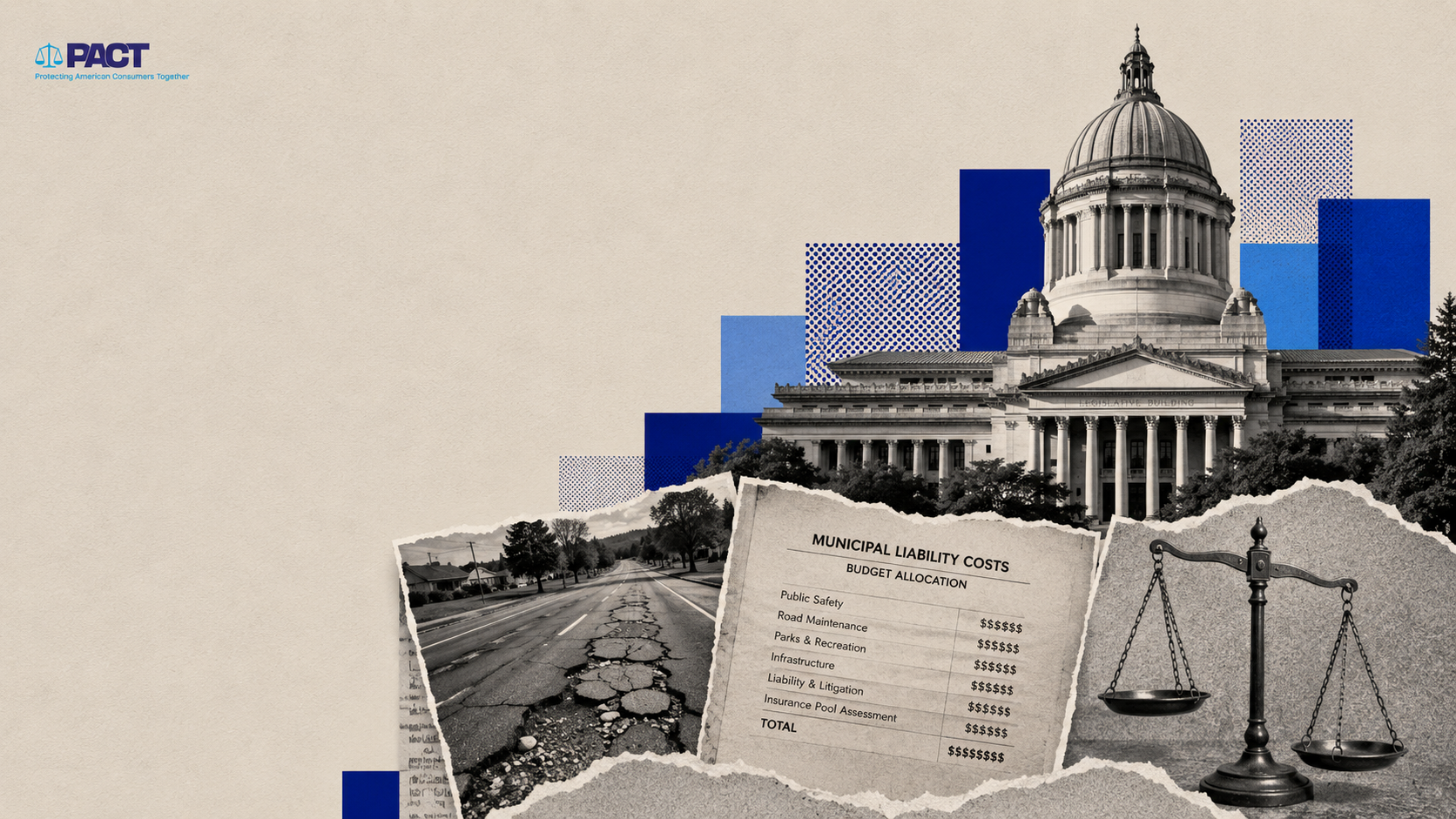
That dynamic has produced an entire category of claims Bennett described as negligent road design lawsuits, in which cities are targeted not because a road is genuinely dangerous but because an at-fault driver lacks assets. “You rarely see road design claims when a UPS truck or a business entity is the at-fault party,” she noted. When city councils override their traffic engineers and install infrastructure that does not meet engineering standards, the exposure multiplies. The worst outcome, Bennett said, is when a city cannot produce a traffic study because none was ever done.
The costs flow directly to taxpayers. Bennett was clear: “As a nonprofit, I have to charge cities more when large verdicts come in. I would rather that money stay in communities, funding things like road maintenance.”
We’ve seen this noted in Los Angeles, where the city’s administrative officer told the city council that lawsuit abuse was “busting the city’s budget” with liability payouts topping $240 million in a single fiscal year. “Every dollar that goes towards a liability payout due to a lawsuit is reducing a city service,” he said. Other cities, like Detroit, are affected by the same issue.
The good news is that reform works. Florida’s lawsuit abuse reforms produced auto insurance rate reductions between 6% and 10.5% among major carriers and a 90% drop in auto glass litigation. Georgia passed sweeping reforms earlier this year and was removed from the “Judicial Hellholes” list for the first time in years. Washington and every other state whose cities are being drained by an unbalanced legal system deserve the same relief.